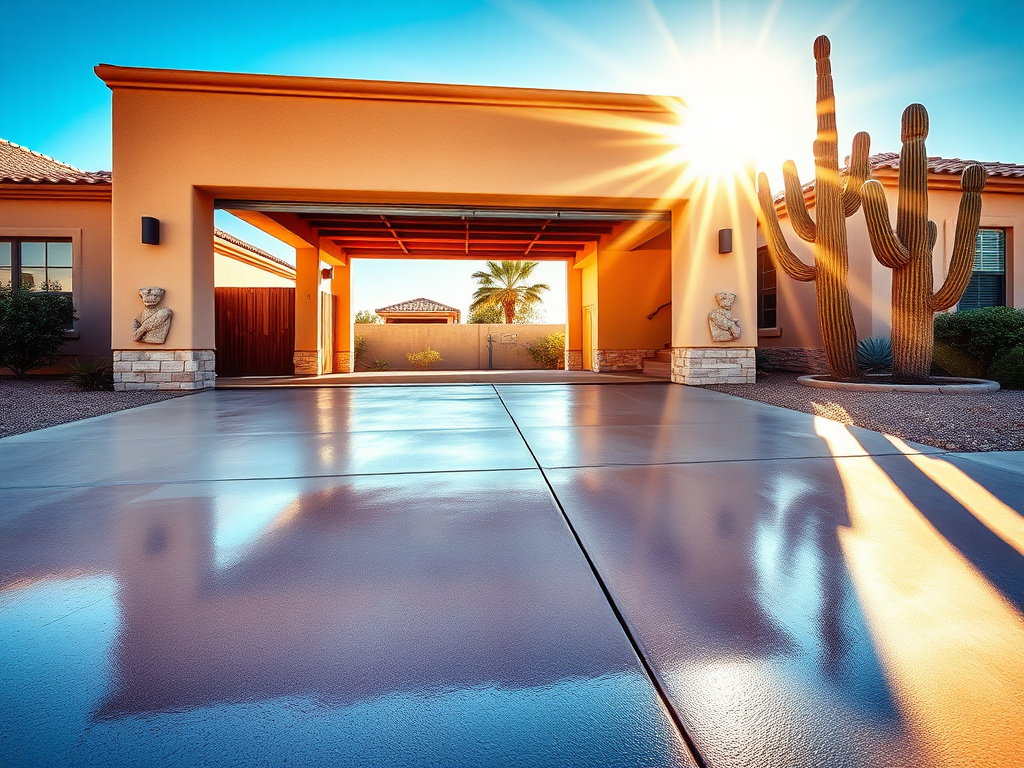
You have finally decided to get your garage floor coated, you start calling around in July, and someone tells you to wait until fall — "you can't coat in the summer, the heat messes up the curing." Now you are stuck wondering if you have to park on bare, stained concrete for three more months while the Valley bakes. It is a common piece of advice, and it is not entirely wrong. But it is not the whole truth either.
Here is what a lot of installers will not spell out: the "don't coat in summer" warning is largely an epoxy problem, and even then it is a scheduling-and-skill problem, not a law of physics. With the right product and a crew that knows how to manage slab temperature and timing, an Arizona garage floor can absolutely be coated in the summer — and often gets a better cure than you would expect. Let's separate the real concern from the leftover myth.
Where the Summer Fear Comes From
The advice is not made up. Heat genuinely changes how coatings cure, and with the wrong product it causes real problems:
- Fast, uncontrolled cure. Heat speeds up the chemical reaction. A coating that would give you a comfortable working window at 70°F can kick far too fast on a 120°F slab, setting before the crew can properly lay and finish it.
- Bubbling and outgassing. A hot slab pushes air and vapor up out of the concrete as it warms and cools through the day. If that happens while a coating is curing, you get pinholes and bubbles.
- Flash-off and lap marks. Solvent-carrying coatings flash too quickly in the heat, leaving roller lines and an uneven finish.
Every one of those is a genuine risk. Notice, though, what they all have in common: they are worst with rigid, slower, less heat-tolerant coatings applied without temperature management. In other words, they are mostly epoxy problems — and mostly problems for crews who do not plan around the heat.
Slab Temperature Is the Real Variable
Air temperature is not what matters most — slab temperature is. Concrete is a big thermal mass. It soaks up heat all day and holds it well into the evening, and it can be significantly hotter or cooler than the air depending on the time of day. A good installer does not guess; they measure the slab surface temperature and work to it.
That is why timing beats the calendar. Even in July, the slab is coolest in the early morning after shedding heat overnight. A smart crew starts early, works in the cooler part of the day, keeps the garage door managed to control sun and airflow, and reads the slab rather than the thermostat. The season is not the enemy — an unmanaged hot slab is.
Why Polyaspartic Makes Summer a Non-Issue
Here is the part that reframes the whole question. Polyaspartic coatings have a wide application temperature range and tolerate heat far better than epoxy. They were engineered for demanding, real-world conditions, and they can be installed across a broad temperature band that would give epoxy fits.
Even better, quality polyaspartic systems come in adjustable formulations — the cure speed can be tuned for the conditions. A pro can select a formulation and manage the mix so the working window stays usable even on a warm Arizona day. The same short-set behavior that makes polyaspartic a 1-day install is controllable in skilled hands.
So the summer worry that is very real for epoxy mostly evaporates with polyaspartic. It is more heat-tolerant, its cure is more controllable, and it does not carry epoxy's slow multi-day cure that leaves your floor exposed to a full day-night heat cycle mid-install.
| Season / Condition | Epoxy Suitability | Polyaspartic Suitability |
|---|---|---|
| Cool months (Nov–Mar) | Good | Excellent |
| Spring / fall shoulder | Good | Excellent |
| Peak summer, midday hot slab | Poor — fast kick, bubbling risk | Good — with slab timing + tuned formulation |
| Peak summer, early-morning cool slab | Fair — needs care | Excellent |
How a Pro Manages a Summer Install
A crew that actually knows Arizona does not just show up at noon in July and hope. They:
- Measure slab surface temperature and schedule around it, usually starting early.
- Work in the cooler part of the day and keep sections small so material is laid and finished before it kicks.
- Choose a polyaspartic formulation tuned to the conditions so the working window stays workable.
- Control the door, sun exposure, and airflow to keep the slab and the fresh coating stable.
- Test the slab for moisture before coating, so heat-driven vapor does not blister the finish.
Do all that and a summer install is not a compromise — it is just a normal, well-run job. The homeowners who get burned are the ones who hired a crew that ignored the slab and used the wrong product.
Frequently Asked Questions
So can I really get my floor coated in July or August?
Yes. With a polyaspartic system and a crew that manages slab temperature and timing, a summer install in Phoenix is entirely doable and cures well. The old "wait until fall" rule is aimed at rigid epoxy applied without heat management.
Does the heat make the coating fail faster later?
No — a properly installed floor cures fully and is not weaker for having been done in summer. In fact, once cured, a polyaspartic floor is built to live in exactly this heat every day. What matters is a controlled install, not the month on the calendar.
Why do some installers still say no to summer?
Often because they primarily use epoxy, which is genuinely harder to install in the heat, or because they would rather not do the early-morning, slab-managed work a summer job requires. It is sometimes more about their product and process than about your floor.
Will my garage be usable the same day in summer?
With a 1-day polyaspartic install, you typically walk on it that evening and park the next day — same as any other season. The heat does not extend that timeline when the job is done right.
What is the single most important summer factor?
Slab temperature, managed by timing. A crew that measures the slab and works in the cooler hours with the right formulation can get an excellent result even in peak summer.
Do not let the season put your project on hold. If your garage floor needs coating, we will handle the Arizona heat the right way — with the right product, the right timing, and a floor that is built for 115°F life. Call 844-967-5247 for a free quote and we will tell you honestly the best plan for your slab, summer or not.