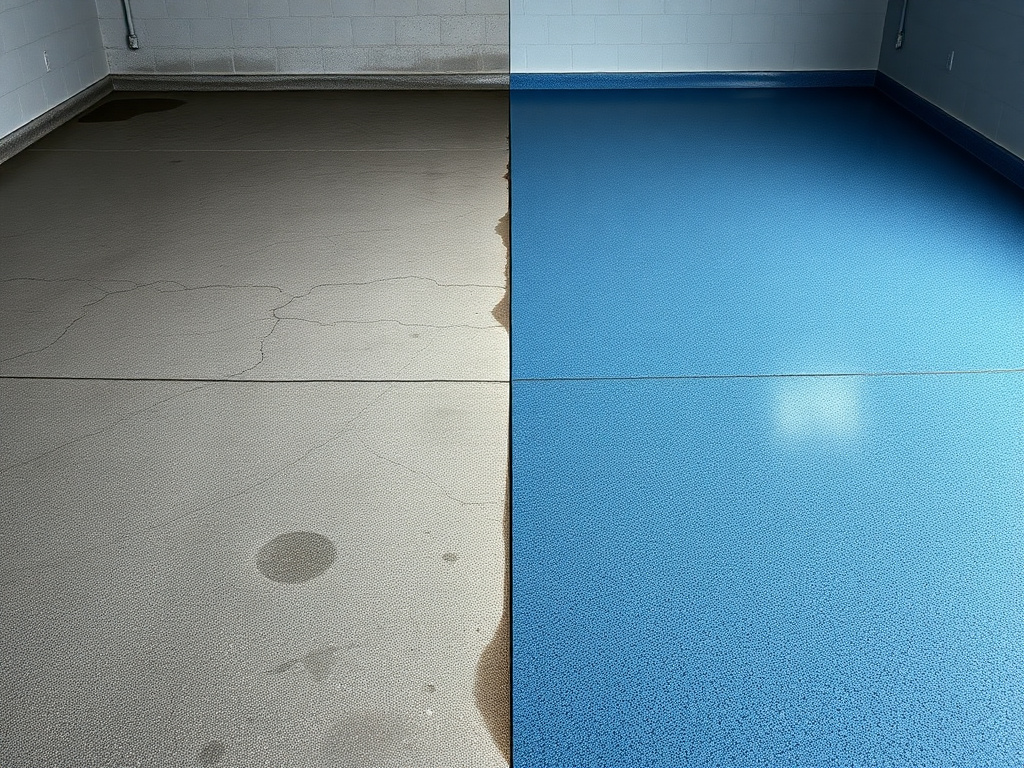
You pull into the garage after a summer errand run, park, and go inside. A week later you back out and there it is: a dark, peeled-up smear right where each tire was sitting. Your coated floor — the one that looked showroom-perfect a few months ago — now looks like something reached down and lifted patches straight off the concrete. That is hot-tire pickup, and in Phoenix it is the single most common way a garage floor coating goes bad.
The frustrating part is that it feels random and unfair, like the floor just decided to fail. It did not. Hot-tire pickup is a predictable, understood mechanism, and once you know what causes it you can see exactly why cheap floors lift here and why the right coating does not. Let's break it down.
What Hot-Tire Pickup Actually Is
Hot-tire pickup (installers call it HTP) is when a coating releases from the slab and sticks to your tire instead. The tire literally peels the coating up as you drive away.
Here is the chain of events. Your tires roll for miles on hot pavement and heat up — a lot. Rubber is full of oils and plasticizers that soften and get tacky as they warm. You park, and that hot, softened tire presses against the coating under the full weight of your vehicle. As the tire slowly cools, it contracts and grips the surface hard. If the bond between the coating and the concrete is even slightly weaker than that grip, the tire wins — and lifts a patch of coating off the slab.
It is not the coating "melting." It is a bond battle: tire-to-coating versus coating-to-concrete. Whichever bond is stronger, wins. On a cheap floor, the tire wins.
Why Arizona Heat Makes It So Much Worse
Hot-tire pickup happens everywhere, but Phoenix turns it up to eleven. Our asphalt sits in direct sun and routinely climbs past 150°F on a summer afternoon. Tires rolling on that come home far hotter, and far softer, than they ever would in a mild climate. Hotter tire equals tackier rubber equals a stronger grip on your floor.
Layer on our slab temperatures — garage concrete well past 115°F — and thermal movement in the slab itself, and you have the perfect recipe. The heat that softens the tire is the same heat stressing the coating's bond to the concrete. Phoenix does not just cause hot-tire pickup; it maximizes it.
Why Cheap Epoxy Lifts
Two weaknesses in a typical low-cost epoxy floor make it a hot-tire magnet:
- It is rigid. Standard epoxy cures hard and brittle. It has almost no flex, so instead of stretching with the stress of a cooling tire, it releases in a clean patch.
- The prep was weak. Budget and DIY floors are usually acid-etched, not diamond-ground. Etching leaves a slick, poorly-anchored surface, so the coating-to-concrete bond is weak from day one — exactly the bond a hot tire is trying to beat.
Put a rigid coating on a weakly-bonded slab in a 150°F-tire climate and hot-tire marks in as little as three months are not surprising. They are expected.
The One Coating That Stops It
The fix is a flexible polyaspartic topcoat over a properly prepared slab. It defeats hot-tire pickup on both fronts at once.
First, polyaspartic is an elastomer — it flexes. When a cooling tire pulls on it, the film stretches and holds instead of fracturing and releasing. Second, a real polyaspartic install starts with diamond grinding, which opens the concrete so the coating locks in mechanically. Now the coating-to-concrete bond is far stronger than any tire's grip. The tire cools, contracts, tries to pull — and nothing comes up.
Flexibility plus a genuine mechanical bond is the whole answer. Miss either one and hot tires will find the weakness.
| Coating Type | Hot-Tire Pickup Risk |
|---|---|
| DIY acid-etch epoxy kit | Very High |
| Standard rigid epoxy (etched prep) | High |
| Epoxy base + polyaspartic topcoat (ground prep) | Low |
| Full polyaspartic/polyurea system (ground prep) | Very Low |
How to Tell If Your Current Floor Is at Risk
Not sure whether your existing floor is a candidate to fail? Walk out and check for these signs:
- Dark smears or peeled patches right where your tires park.
- A rigid, glassy, hard finish with no flex — classic standard epoxy.
- You know it was acid-etched, not ground (a weekend DIY kit, or a suspiciously cheap job).
- Yellowing or ambering near the door, which flags a UV-vulnerable epoxy that is also usually the brittle kind.
- Lifting or curling at the edges and around cracks.
- It went down in a single thin coat with no color flakes and no clear topcoat.
Two or more of those, and hot-tire pickup is likely coming — or already starting.
Frequently Asked Questions
Can hot-tire marks be fixed, or does the whole floor have to be redone?
It depends on how far it has gone. Isolated early lifting can sometimes be spot-repaired, but once a floor is peeling in multiple spots the reliable fix is to grind it off and reinstall a flexible polyaspartic system with proper prep. We will tell you honestly which situation you are in.
Will a polyaspartic floor really never get hot-tire marks?
No coating is magic, but a flexible polyaspartic topcoat over diamond-ground concrete makes hot-tire pickup a non-issue for the vast majority of Phoenix garages. The flexibility plus the strong mechanical bond removes both causes at once.
Do I need to let my tires cool before parking?
On a properly installed flexible system, no — you can park normally. That is the whole point of using the right coating. The "let your tires cool" advice is a band-aid people use to baby a floor that was built wrong in the first place.
Why did my professional epoxy floor still get tire marks?
Usually one of two things: the epoxy was rigid with no flexible topcoat, or the prep was etch instead of grind, leaving a weak bond. Both are fixable by reinstalling the right system with real prep.
If your garage floor is smearing, peeling, or you just want to make sure your next one never does, let's take a look. We will inspect your slab, explain exactly what is happening, and build you a floor that laughs off Phoenix hot tires. Call 844-967-5247 for a free quote today.